History

It is a long established fact that a reader will be distracted by the readable content of a page when looking at its layout. The point of using Lorem Ipsum is that it has a more-or-less normal distribution of letters, as opposed to using ‘Content here, content here’, making it look like readable English. Many desktop publishing packages and web page editors now use Lorem Ipsum as their default model text, and a search for ‘lorem ipsum’ will uncover many web sites still in their infancy. Various versions have evolved over the years, sometimes by accident, sometimes on purpose (injected humour and the like).

Christian symbols in Roman cities
Christianity in Pompeii

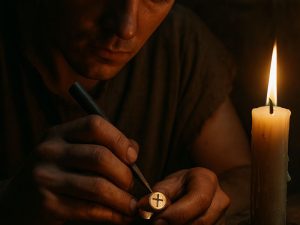
Tracing the Cross: Christian Symbols in Roman Cities

Introduction Long before Christianity became legal—before churches rose or bishops argued doctrine—some followers of Jesus left behind signs. Not letters or sermons, but scratches on walls, shapes in rings, and crosses in unexpected corners. Their faith wasn’t proclaimed in marble

Read More »
Christian slaves in Pompeii
Christianity in Pompeii

Christian Slaves in Pompeii: Faith Beneath the Household Gods

Introduction In the grand homes and modest workshops of Pompeii, slaves were everywhere—and so, perhaps, was belief. While some gods could be praised aloud and their images displayed openly, Jesus-devotion came with shadows, uncertainty, and risk. Public religion was performative,

Read More »
Christian references in Pompeii
Christianity in Pompeii

Faith in the Taverns? Christian references in Pompeii

Introduction Inns were places of transition—where strangers met, meals were served, and stories exchanged. But in Pompeii, one inn may have housed more than just travelers. It may have preserved a fleeting reference to one of history’s most significant spiritual

Read More »
Large bathhouse of Pompeii
Latest News About Pompeii

The Large Bathhouse of Pompeii: A Once-in-a-Century Discovery

Introduction Buried beneath volcanic ash for centuries, Pompeii has fascinated the world with its preserved snapshots of Roman life. From vibrant frescoes to bustling marketplaces, this ancient city reveals endless insights into a civilization lost to disaster. Even in a

Read More »
Christian households in Pompeii
Christianity in Pompeii

Christian Households in Pompeii: Faith Behind Closed Doors

Introduction When we imagine ancient Christianity, we often think of catacombs, basilicas, or martyrdoms. But the reality in Pompeii may have looked very different. The Christian households in Pompeii were neither grand nor openly defiant; they were modest, quiet, and

Read More »
Sator square
Christianity in Pompeii

The Sator Square and Christianity: Ancient Puzzle or Hidden Creed?

Introduction Few inscriptions from the ancient world have generated as much fascination—and speculation—as the enigmatic Sator square. Found in multiple locations across the Roman Empire, including at least two in Pompeii, this five-word palindrome has long intrigued scholars, mystics, and

Read More »
Christian graffiti in Pompeii
Christianity in Pompeii

Christian Graffiti in Pompeii: Whispered Faith on the Walls

Introduction In Pompeii, walls spoke. Graffiti was everywhere—satirical, romantic, political, vulgar, poetic. Amid this chorus of ancient voices, one faint inscription has captured the attention of modern scholars and believers alike. It may be the earliest reference to Jesus-followers in

Read More »